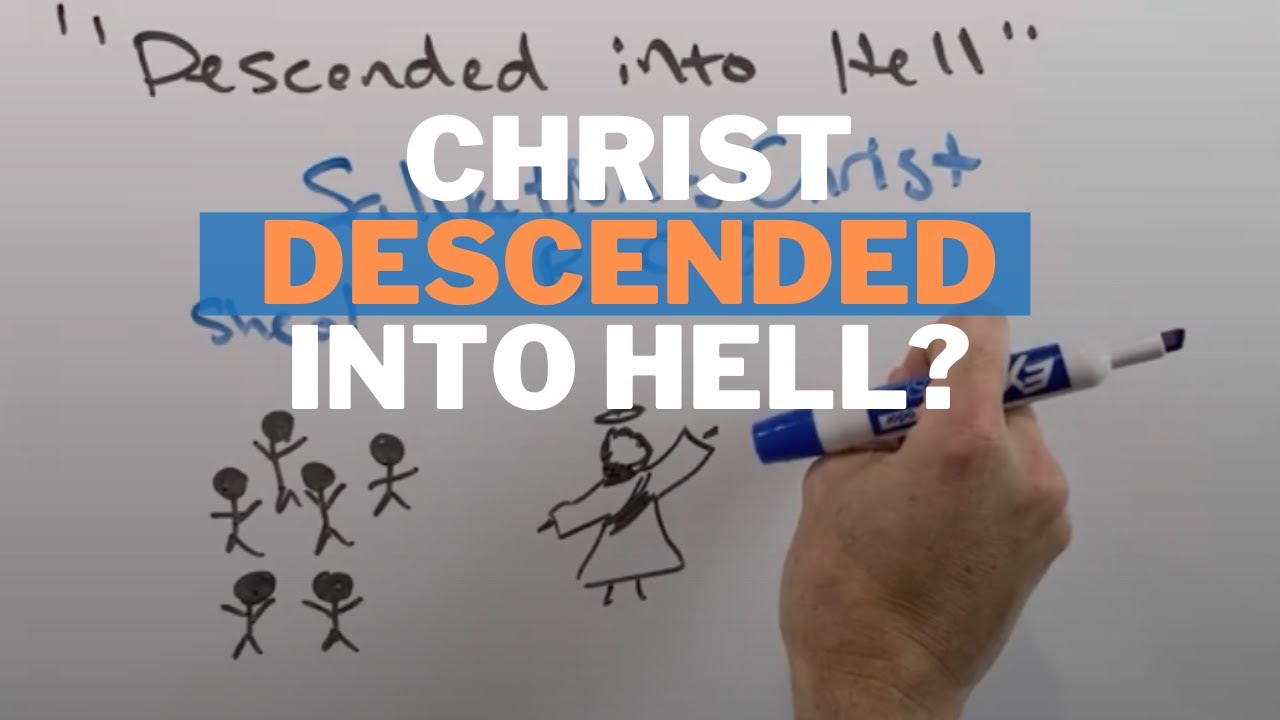
All my long life (I’m 90) I have been confused with this Creed sentence “He descended into Hell”. This seems a contradiction- surely Our Blessed Lord would never enter that place or condition.
What biblical or other source justified the Nicenean Assembly introducing this sentence.
Thank you Stephen. Your language expression is very advanced and quite poetic but difficult for my old mind to fully understand. Would you be able to break it down into simple everyday language ?
And the biblical origins leading to its inclusion in the Creed ?
Lawrence
Gotta love their choice of words right? Their translations are terrible anymore. Someone explained to me that Jesus went to like a holding place and on the 3rd day went to Heaven (or something like that). I hate the modern translations, cause so much is lost every time you retranslate something. Like, when Jesus says he’s the son of God, he didn’t literally mean he was God’s son. Son back then took on a different meaning.
Yeah, they really need to stop with the retranslating. But, that’s man for ya….always trying to regain some corrupt level of control. This Matrix is really something.
1 Like
He types with such a purity. I love this guy!
1 Like
And I think the older translation was “He descended to the dead.” Hell is a poor choice in this case.
Am I to understand the reply was AI generated ?
Yes I do recall seeing that form used many years ago - it makes more sense to me
Probably. That 2-letter word is full of misinformation. Be careful when using one.
Just a general tip, but everytime you type that 2-letter word, it will start to track you. Be careful.
1 Like
I just looked up the Nicene Creed and didn’t see anything about Christ descending into Hell. Maybe you mean the Apostles’ Creed, which is shorter but says mostly the same things? Years ago, I heard a priest (who could read Greek; I can’t) say that Hell was the Greek concept for the abode of the dead and didn’t have our modern meaning of Hell. He said “descended to the dead” would be more accurate, and that’s how I pray the Apostles’ Creed.
I used to have the Nicene Creed memorized, and once in the 1980s, when someone asked me what Catholics believe, I recited the Nicene Creed and afterward answered one or two questions. Then the Church changed the Nicene Creed for the second time in my life, and after that I couldn’t remember either version correctly. If they’re going to change it every 45 years or so, I can’t keep up.
At my local parish (Holy Spirit) at each Sunday Mass recitation of the Nicene Creed uses the words “….. descended into Hell”.
At Saint Patrick’s Cathedral Sunday Mass (which I attended last Sunday) the Nicene Creed uses the words “….. He suffered death and was buried”, in place of the former.
I asked my parish priest about this variation a while back - he said both versions were validly commonly used.
I note you refer to Limbo and to Purgatory, but not to Hell - why not ?
OK thank you.
It seems plausible that Our Lord might on His death ‘descend into Limbo and Purgatory for the reasons you state’, but the Creed doesn’t say that, rather it refers to His descent into Hell.
So back to my original question - Why would Our Lord need to descend into Hell ? And from what scriptural source did the Nicene Councillors secure this idea.
I stress these are my perhaps simplistic wonderings’ and I don’t expect any definitive responses.
Well…I personally think Jesus didn’t descend into Hell and that they got Jesus’s life completely wrong. And that’s because, if we had a truly original Bible, it would be 777 books. But in our current Bibles, we only have 66 books. So we only have a fraction of the truth. I personally think Jesus’s life was very different than what we are told, especially growing up. But, you can thank the Church Hierarchy for saying that those books that were taken out are heretical. I blame the hierarchy, we’re huemans and we’re not stupid. Give us the missing books, let us read them, and make up our own minds about them. If these books are heretical like they say, then we should be able to arrive at the same conclusion, correct?
Subtlety is how the Devil plays. It’s through subtlety is why we have the problems in this life the way we do. Because at some point, our ancestors agreed to how this society functions, and society is highly dysfunctional. Most homes are dysfunctional too. And the 7 families who ran this sh*tshow wanted it to be exactly like this. Nice group of people huh?
This pooped up in my feed this morning : )
I don’t see any stains from the poop.
Just kidding, I knew what you meant lol.
Ha-Ha! : ) I’ll leave it, because it is funny. I was still half-asleep when I posted : )
StephenAndrew
You seem to mainly apply allegorical interpretations to many events in the life, death, resurrection of Our Lord and that’s quite nice, indeed of poetic quality. For me the simpler expression of the words of scripture suffice, as they do for most.
I do wonder about the source of such advanced interpretations - do they derive from the writings of Christian scholars over the millennia, or are some of your own creation, inspired as it might be.
I had no knowledge of Valtorta or her writings before seeing the reference on this site. I note in recent exploring about her works there is no Vatican imprimatur and there have been Vatican issued statements refuting any supernatural origin. But that’s (IMO) not to say her works are devoid of true spiritual value - I cannot judge being ‘unread’.
Perhaps you and others have read the deeply research based book by Spanish theologian Jose A Pagola “Jesus - An Historical Approximation”. It makes no claim of supernatural origin simply of deriving from 30 years of extensive research of the study by scholars of the subject be they Jewish, Christian, Islamic even nontheists.
This book brought Jesus brilliantly to life for me as never before, particularly in His humanity but in His divinity too. It has no imprimatur, and was originally on the Vatican refuted list but as I recall after some re-editing by Pagola it became acceptable. Its comprehensive references to dozens of scholarly studies is a real jewel.
1 Like
Hello Lawrence,
… Some thoughts …
The meanings of hell, as I understand, in the Creed, is referring not to eternal damnation, but to the place which can be akin to our modern idea of purgatory, or a kind of netherworld from the common understanding of that period in time.
In this sense, Jesus, would have spent (some) of those 3 days, there … where the souls of the dead before Him, reside …
~
(my paraphrasing understandings drawn from the latter … below )
~
When Jesus rose, on Easter Sunday, he returned from that ‘hell’, with those souls he has brought forth from purgatory to ascend to heaven with Him. (I think there are paintings of Fra Angelico regarding this).
~
For example… When I say the Creed before Rosary,
I emphasize in my own heart, at this point …
~ “ He descended into Hell; …
~ (In thought, here, I add to the latter .. ‘for the resurrection of souls’ )
~" the third day He arose again from the dead;
Open and asking for suggestions,
Take care,
Michael